The Fall and the Self
The Fall changes not only how man sees God. It changes how man sees himself.
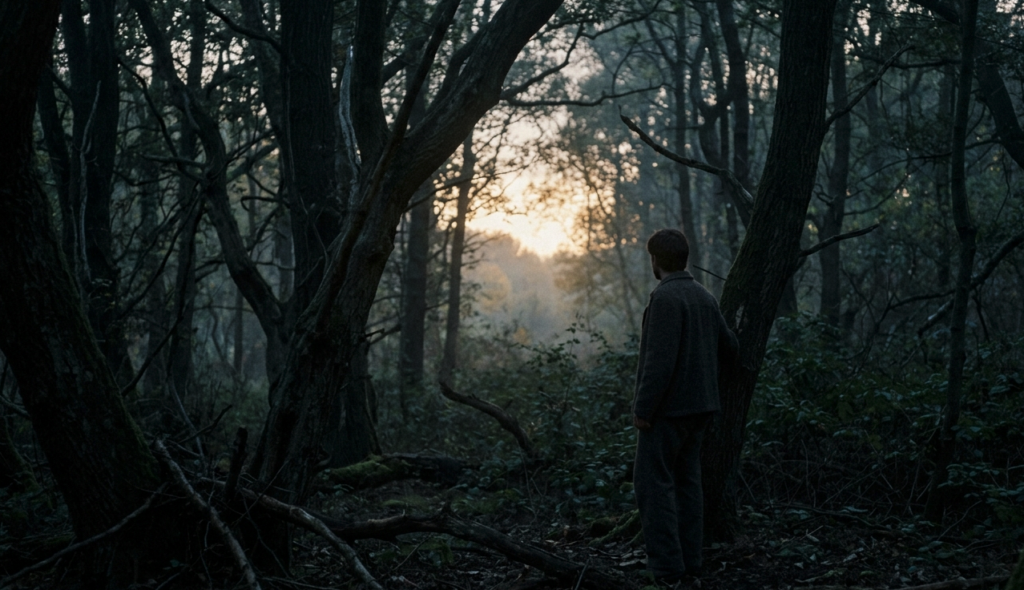
When God Draws Near, Man Becomes Visible
Fear enters Scripture very early.
Not first as terror, but as exposure.
Adam hides among the trees. Israel trembles before the mountain. Isaiah falls to the ground crying, “Woe is me.” The disciples fear most not during the storm, but after the sea becomes calm.
This pattern repeats so consistently throughout Scripture that it begins to reveal something fundamental about the Divine Dialogue itself.
Modern man often imagines the problem differently. We tend to assume that distance from God is caused primarily by God’s absence. Scripture repeatedly suggests something far more unsettling: the closer God draws, the more clearly man begins to see himself.
This is why the encounter with God so often produces fear before it produces peace.
Not because God delights in terror. Not because holiness is cruelty. But because the human person is suddenly standing within a light that cannot be negotiated with. A gaze that sees completely. A presence before which rehearsed versions of the self begin to fail.
Adam hides.
The disciples ask:
“What manner of man is this?”
Isaiah says:
“I am a man of unclean lips.”
Peter falls at Christ’s knees:
“Depart from me; for I am a sinful man, O Lord.”
The exposure is different in each case, but the movement is the same. God speaks, and man becomes visible to himself.
This is one of the recurring patterns hidden within the biblical narrative:
God speaks → Man responds → Christ fulfils
The Divine Dialogue is never merely the transmission of information. It is revelation in the deepest sense: not only God revealing Himself, but man being revealed in the presence of God.
And this explains something important about fear in Scripture.
The fear of God is not always fear of punishment. Very often, it is the fear that accompanies recognition. The terrifying realisation that we are not hidden nearly as successfully as we imagined. The discovery that the voice calling “Where art thou?” has always known where we were.
Yet Scripture does not leave the story there.
Adam hides among the trees.
At Calvary, God hangs exposed upon a tree for man.
The movement of redemption is not God demanding exposure while remaining distant Himself. It is God entering exposure fully. Nothing concealed. Nothing protected. Nothing held back.
This is why the Cross stands at the centre of the Divine Dialogue.
The one from whom man hides is the same one who refuses to hide from man.
And perhaps this is why the question continues echoing through every age of Scripture and every human life:
“Where art thou?”
Not asked for information.
Asked because the first step toward healing is often the moment a man finally stops moving away.