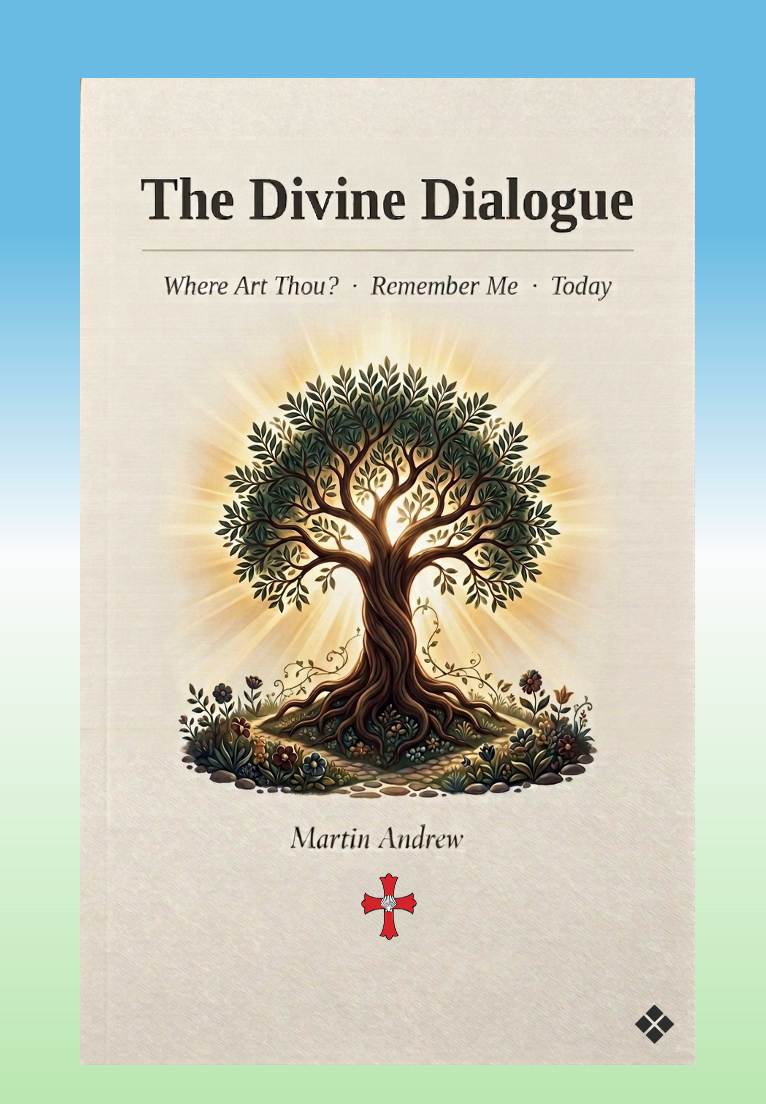
The Divine Dialogue
A Trilogy of Question, Answer, and Fulfilment
Scripture is one.
From the first call of God in the garden,
“Where art thou?”
to the final promise spoken by Christ,
“Today shalt thou be with me in paradise”
a single dialogue unfolds.
God seeks.
Man responds.
Christ fulfils.
This work is a meditation on that dialogue.
Structured as a trilogy, The Call, The Response, and The Fulfilment, it traces a single movement across the whole of Scripture: from the question addressed to fallen man, to the answer given at the hour of death, to the word of Christ that brings the dialogue to completion.
Drawing upon Sacred Scripture and read in continuity with the tradition of the Church, it seeks not to innovate, but to illuminate the unity and depth of divine revelation fulfilled in Jesus Christ.
❖
Offered as a lay Catholic meditation upon Sacred Scripture,
in fidelity to the teaching of the Holy Church.
“Speak, Lord; for thy servant heareth.”, 1 Samuel 3:9
M.A.
the4th.ch
Chapter I
“Where Art Thou?”
A Biblical Theology of Man Before God
Introduction
Among the questions of Scripture, few carry greater weight than that asked by God in the garden of Eden: “Where are you?” (Genesis 3:9). It is the first question God addresses to man after the Fall, and it echoes, implicitly or explicitly, across the entirety of the biblical narrative. From the expulsion in Genesis to the restoration in Revelation, the sacred text can be read as a sustained divine inquiry into the location, condition, and orientation of the human soul.
This paper proceeds by the method of biblical theology, tracing a single canonical theme from creation to new creation, following the question “Where are you?” through the major movements of biblical history. It will be argued that “Where are you?” is not merely a narrative detail but the question that orders the whole of all biblical anthropology.
I. Eden: Man, Fully Present Before God
Genesis 1to2 describes a state of unmediated communion between God and humanity. There is no barrier, no internal division, no concealment. When the text records that “they heard the voice of the LORD God walking in the garden” (Genesis 3:8), it implies that such proximity was ordinary, the natural environment of human life.
The detail preserved in Genesis 2:25 illuminates this with striking precision: “And they were both naked, the man and his wife, and were not ashamed.” This nakedness is not primarily a physical description. It is an ontological one. Nothing in the man or the woman resisted being seen. There was complete transparency before God, before each other, and before themselves.
This condition of presence is the standard against which the entirety of redemptive history must be measured. Everything that follows is a departure from it and, ultimately, a movement back toward it.